Last updated
Aug 19, 2026
Last updated
Aug 19, 2026



Summary
- Competitor analysis tools can be classified into three categories, based on their capabilities and business functions that they cater to: purpose-built competitive intelligence platforms, SEO and digital marketing tools, and social media monitoring tools.
- The list of the best competitor analysis tools includes Contify, Crayon, AlphaSense, Semrush, Similarweb, Ahrefs, Moz Pro, Brandwatch, Sprout Social, Talkwalker, and Meltwater.
- Every tool that is mentioned in this blog is best for conducting competitor analysis. However, choosing the best competitor analysis tool for your organization depends on your unique business goals, such as what you want to track, which teams will use the reports, and what outcomes you want to derive.
Competitor analysis tools help you to monitor, gather and analyze specific data about your rival companies at scale and offer actionable insights so you don’t have to do it all manually. But when it comes to choosing one for your company, there are plenty of options to choose from. It isn’t only the wide selection of tools available that causes challenges. Competitor research means vastly different things depending on who’s doing it, and what the rest of the team is hoping to achieve.
For instance, a competitive intelligence (CI) manager running an organization-wide intelligence program has fundamentally different needs from a growth marketer benchmarking keyword rankings or a brand team tracking how competitors show up on social media. While all require competitor research, the tools required for each differ.
This is where many teams struggle. Users either select a solution that doesn’t fit their actual needs, or use products/services that still don’t cover the most crucial signals.
To simplify this, we have organized the best competitor research and analysis tools in 2026 into three distinct categories:
- Purpose-built competitive intelligence platforms for teams running continuous, cross-functional intelligence programs
- SEO and digital marketing tools for teams tracking competitors’ organic, paid, and content strategies
- Social media monitoring tools for teams focused on brand presence, audience engagement, and share of voice
The 11 Best Competitor Analysis Tools in 2026
- Contify: best suited for delivering real-time AI-powered market and competitive intelligence to help businesses track competitors, industry trends, and strategic insights.
- Crayon: best suited for enabling B2B revenue teams with real-time competitive intelligence and battlecards to win deals and respond effectively to competitors.
- AlphaSense: best suited for investment and corporate research teams to quickly extract insights from earnings calls, filings, and expert transcripts.
- SEMrush: best suited for marketing teams to analyze search rankings, keywords, and competitors to improve SEO and digital visibility.
- Similarweb: best suited for digital marketing, strategy, sales, research, and competitive intelligence teams that need market, traffic, audience, app, and competitor insights across digital channels.
- Moz Pro: best suited for marketing/SEO teams needing an all-in-one SEO suite for DA/PA analysis, keyword research, rank tracking, backlink analysis, and site audits.
- Ahrefs: best suited for SEO and marketing teams that need competitor analysis, backlink analysis, keyword research, rank tracking, content research, and technical site audits.
- Brandwatch: best suited for insights and marketing teams to analyze social media data at scale for brand perception, campaign performance, and audience trends.
- Sprout Social: best suited for social media managers to schedule posts, reply to messages, and generate performance reports across multiple social accounts from one platform.
- Talkwalker: best suited for communications and insights teams to monitor online mentions across social, news, and web sources and analyze sentiment and trends.
- Meltwater: best suited for PR and communications teams to track and analyze media coverage across news and social channels to measure brand visibility and reputation.
What is a Competitor Analysis Tool?
Competitor analysis tools are software platforms that automatically collect, monitor and analyze information about your competitors. They help you understand competitors’ products, pricing, marketing strategies, and market position by gathering data from multiple sources. By comparing these insights with your own business reports, you can tap into market gaps for your benefit, uncover growth opportunities, anticipate competitor moves, and make better strategic decisions.
Best Competitor Analysis Tools at a Glance
| Tool | Category | Best for | Starting price | Free plan/trial |
| Contify | CI platform | Enterprise cross-functional CI programs | Custom (contact sales) | 7-day free trial |
| Crayon | CI platform | Revenue teams tracking digital footprint changes | Custom (contact sales) | Demo only |
| AlphaSense | CI platform | Finance, strategy, and investment research | Custom (contact sales) | Demo only |
| Semrush | SEO tool | All-in-one digital competitor benchmarking | Starts at $139/month | 7-day free trial |
| Similarweb | SEO tool | Traffic and audience benchmarking | Starts at $199/month | Limited free version |
| Moz Pro | SEO tool | SMBs and teams new to structured SEO workflows | Starts at $99/month | Free trial (7–30 days, varies) |
| Ahrefs | SEO tool | Backlink and content-gap analysis | Starts at $129/month | No free trial; limited free tools |
| Brandwatch | Social tool | Enterprise-scale social listening | Custom (contact sales) | Demo only |
| Sprout Social | Social tool | All-in-one social management + competitor benchmarking | Starts at $199/month | 30-day free trial |
| Talkwalker | Social tool | Real-time global brand monitoring | Custom (contact sales) | Demo only |
| Meltwater | Social tool | PR/earned-media + social monitoring | Custom (contact sales) | Demo only |
Best Competitor Analysis Tools for Market and Competitive Intelligence
Purpose-built competitive intelligence platforms cater to continuous end-to-end processes. They aggregate signals from across the web, news, social, internal, and other sources rather than just from one channel, using AI to filter out the noise and classify the resulting updates, thus providing structured insights to the teams that rely on them.
These platforms were designed for mid to large size organizations, making competitive intelligence a recurring program that serves many functions, like:
- One place to track competitors, customers, partners, key accounts, and industry trends.
- Minimize noise using AI-based filtering, tagging, and summarization.
- Use structured formats such as SWOT analyses, competition profiles, and battlecards.
- Get everyone involved who is in the decision-making process.
The aim is not merely to monitor competition but to build a layer of intelligence that teams can rely on to make better decisions, fast.
1. Contify
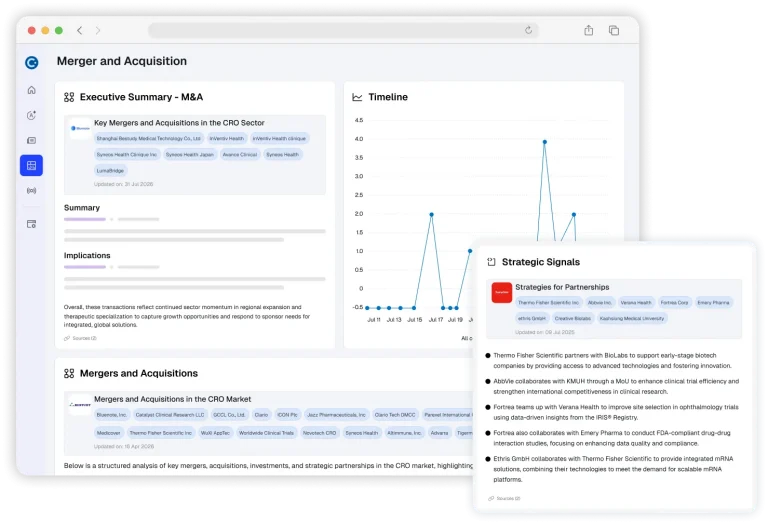
Contify is a purpose-built, AI-native market and competitive intelligence (M&CI) platform that brings together decision-ready signals on competitors, customers, partners, key accounts, and industry trends into a single, continuously updated intelligence program. It is designed to scale across strategy, product, marketing, and sales teams, enabling them to work from a shared intelligence layer and respond to market changes faster and with greater confidence.
Founded in 2009 by Mohit Bhakuni, Contify serves Fortune 500 companies and high-growth enterprises such as Deloitte, EY, IQVIA, Lenovo, and Wipro across use cases, including opportunity identification, sales enablement, and go-to-market strategy.
Key features of Contify
- Extensive source coverage: Monitors 1M+ global sources across 700K+ companies, unifying external and internal intelligence in one platform.
- Noise-free intelligence feeds: AI-powered filtering with human curation delivers highly relevant, deduplicated, and insight-ready updates.
- Ask Athena & live company profiles: Natural language Q&A and dynamic company profiles provide real-time, consolidated strategic insights.
- Robust taxonomy & custom tags: Flexible, AI-driven taxonomy with 100+ categories and custom tagging tailored to your market and workflows.
- Automated insights & analysis: Agentic AI transforms raw data into continuously updated, decision-ready insights and strategic frameworks.
- Dashboards, alerts & distribution workflows: Role-based dashboards, real-time alerts, and seamless integrations ensure insights reach the right stakeholders instantly.
Contify’s M&CI platform is a great fit for mid-to-large enterprises where competitive intelligence needs to support multiple teams. It is particularly effective in industries such as IT/ITeS, SaaS, BFSI, consulting, manufacturing, pharmaceuticals, and healthcare, where teams rely on continuous, structured intelligence delivered through feeds, alerts, dashboards, newsletters, company profiles, and battlecards.
Who is Contify best suited for?
Contify is best suited for mid to large enterprises that need cross-functional, continuous, and prescriptive competitive and market intelligence to improve strategic decision-making across marketing, sales, product, and corporate strategy.
Pros:
- Delivers clean, noise-free intelligence from over 1 million vetted external sources and internal business systems.
- Highly customizable and scalable, catering to businesses of all sizes and industries.
- Translates and surfaces intelligence from over 117 non-English languages.
- Offers a human-in-the-loop step for verifying data at scale.
- Provides immediate and excellent customer support, resolving queries in a timely manner.
- Contify allows unlimited users to use the platform without charging additional cost, making intelligence reach organization-wide.
Cons:
- The platform offers extensive feature sets and customization for taxonomies, dashboards, and workflows, which at times creates a learning curve for users.
- Contify is purpose-built to provide strategic competitive insights, which makes it unsuitable for high-volume PR and brand monitoring activities, where the primary focus is tracking media coverage.
Pricing: Contify offers flexible pricing that is tailored to business requirements such as feature sets, number of seats, and how many competitors you want to track.
2. Crayon
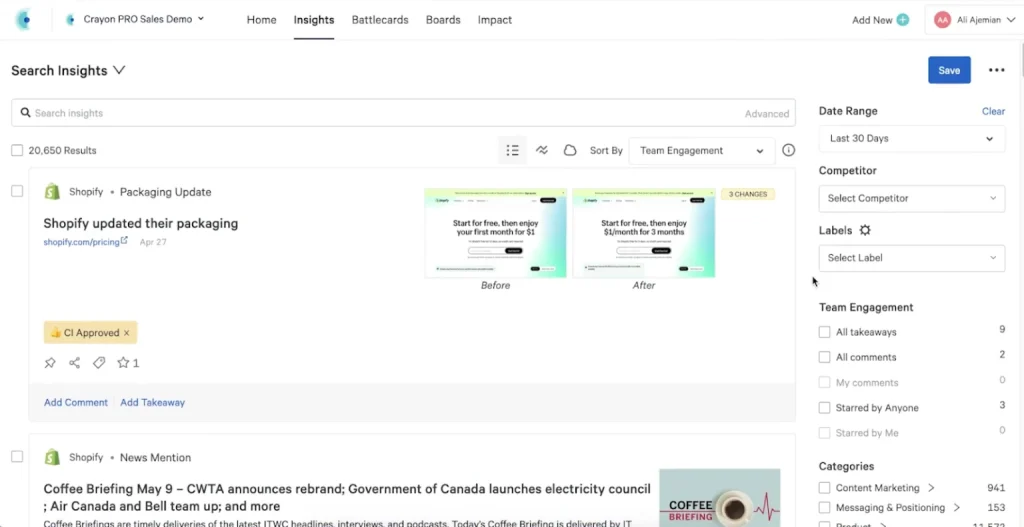
Crayon is a competitive intelligence platform helping teams track competitor activity across digital channels and translate those signals into actionable insights for revenue teams. Its strength lies in capturing changes in competitors’ online presence and delivering that intelligence directly into the workflows used by sales and marketing.
It is particularly effective in environments where staying up to date on competitors’ messaging, pricing, and positioning is critical to winning and retaining deals.
Key features of Crayon
- Website & digital footprint monitoring: Continuously tracks competitor website changes to reveal real-time shifts in pricing, messaging, and positioning.
- Custom data collection across sources: Aggregates intelligence from multiple sources with configurable queries tailored to your competitive focus.
- Centralized battlecard management: Enables creation and distribution of battlecards integrated into sales workflows for in-context competitive insights.
- AI filtering & summarization: Uses AI to surface key changes and deliver concise summaries of important competitive developments.
- Enterprise integrations for workflow alignment: Integrates with CRM, sales, and collaboration tools to embed insights into everyday workflows.
- Customizable dashboards: Provides flexible dashboards organized by competitor, topic, or function for shared organizational visibility.
Who is Crayon best suited for?
Revenue teams where staying current on competitors’ messaging, pricing, and positioning is directly tied to winning and retaining deals.
Pros:
- Tailored for competitive enablement, GTM strategy, and sales enablement.
- Offers a “Field Agent for Slack”, an AI model that connects with Slack, directly captures useful insights from frontline sales teams, and automatically updates reports and battlecards.
- Seamlessly integrates with daily sales and CRM tools such as HubSpot, Salesforce, Slack, and Gong.
Cons:
- Crayon provides limited historical data, which makes understanding long-term competitor patterns, performing benchmarking activities, or conducting trend analysis a challenge.
- It is more focused on competitor enablement, which means you get little to no context about what is happening in the broader market, an important requirement for comprehensive competitive intelligence workflows.
- Crayon typically charges on a per-competitor basis as part of its pricing model, which can become expensive for most businesses.
Pricing: Crayon does not mention pricing details on its official website. According to the HubSpot listing, Crayon’s starting price is $15,000 per year.
3. AlphaSense
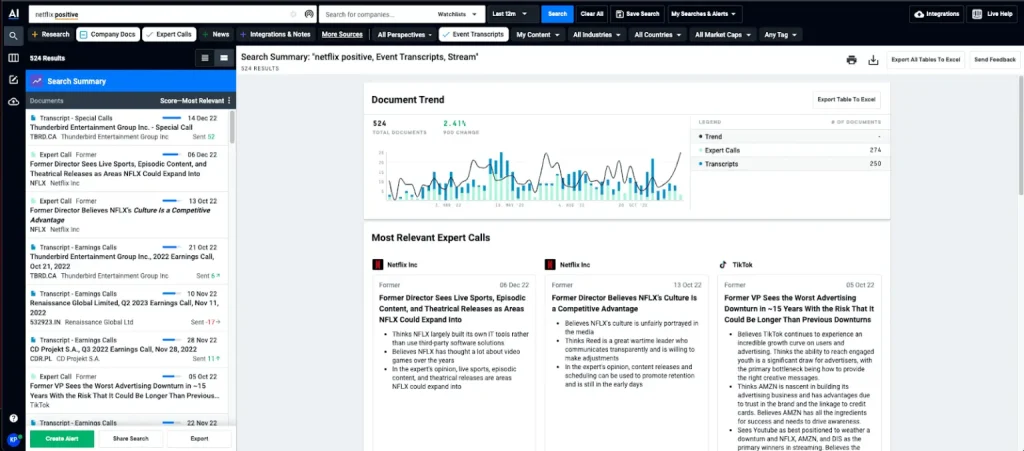
AlphaSense is a market and competitive intelligence platform focusing on premium financial content, AI-powered search, and deep research workflows. It is designed for finance, strategy, and investment professionals who need to conduct detailed company and market analysis using institutional-grade data.
Founded by Jack (Jaakko) Kokko and Raj Neervannan in 2011, it is widely used by financial services firms, management consultancies, and large enterprises, including many S&P 100 companies.
Key features of AlphaSense
- Premium content library: Aggregates high-value sources like filings, earnings calls, broker research, and news into a unified research platform.
- Expert transcript library (Tegus): Provides access to expert call transcripts with industry specialists for deeper, primary research insights.
- Generative AI suite (Deep Research & Generative Grid): Enables multi-step research and cross-document analysis to extract structured insights at scale.
- AI-powered sentiment tracking: Analyzes tone and sentiment in transcripts to surface strategic signals and shifts.
- Smart alerts & monitoring: Delivers real-time alerts on companies, industries, and topics with highlighted insights and source links.
Who is Alphasense Best suited for?
Investment and corporate research teams that need to extract insights from earnings calls, filings, and expert transcripts quickly.
Pros:
- The platform offers a wide range of premium or paywalled content, focused on financial-related coverage such as broker research, SEC filings, earnings transcripts, and expert calls.
- It offers a Gen AI suite that performs deep research across its entire content coverage and delivers AI-generated summaries. These intelligence reports are automatically verified and include citations, which helps cater to ad hoc research requests.
- It delivers powerful and contextual intelligence reports through its “Smart Synonyms” feature, which understands the broader context and thematic meaning of a query, rather than sticking to a single keyword.
Cons:
- It is a financial-first intelligence platform, which means it is less suitable for businesses operating in other sectors.
- As the platform leans towards financial use cases, it is less compatible with other in-demand competitive and market intelligence use cases such as marketing, sales enablement, and product intelligence.
- Restricted distribution of intelligence within an enterprise, which means strategic insights remain limited to a few people.
- AlphaSense’s customization capabilities are limited, which can create hindrances in adapting the platform to business workflows.
Pricing: There is no mention of pricing details on the AlphaSense official website. According to Vendr, a median buyer pays $17,500 per year.
Best SEO and Digital Marketing Competitor Analysis Tools
SEO and digital marketing competitor analysis tools are designed for teams that need a channel-specific view of competitive performance, especially across search, paid media, and content.
Unlike purpose-built competitive intelligence platforms, which focus on broad market signals, these tools are centered on digital performance data. They help teams understand how competitors attract traffic, rank for keywords, invest in ads, and build visibility across online channels.
These tools are typically used to answer questions such as:
- Which keywords are competitors ranking for, and where are the gaps?
- How are competitors allocating spend across paid search campaigns?
- What backlink strategies are driving their authority?
- Which content themes and formats are generating traffic and engagement?
- How is competitor visibility evolving across organic and paid channels?
Most platforms in this category combine large-scale data collection with analytics and reporting, enabling teams to benchmark performance, identify opportunities, and refine their digital strategies based on competitive signals. They become extremely useful for SEO teams focused on organic growth, performance marketers managing paid campaigns, content teams planning and optimizing content strategies and growth teams analyzing traffic and audience behavior.
4. Semrush
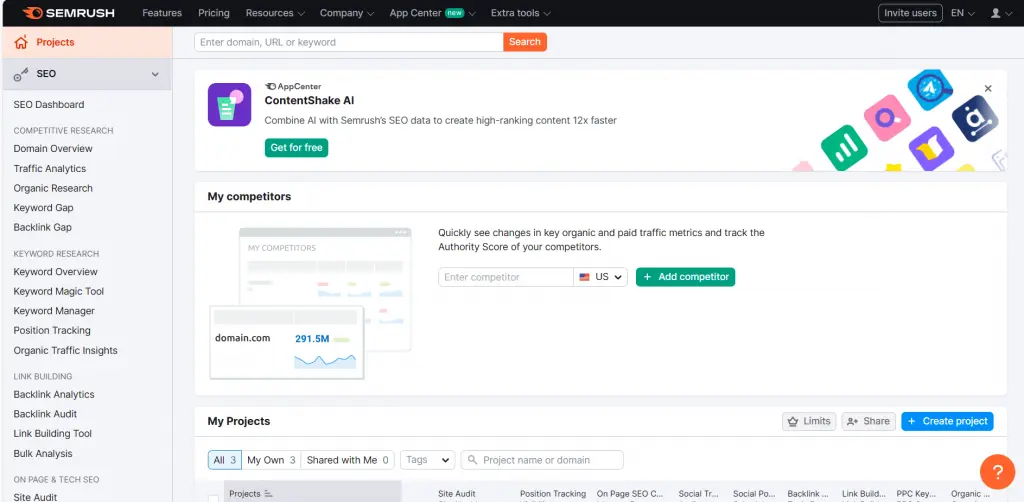
Semrush is a full-suite digital marketing platform with a comprehensive set of competitor analysis tools for SEO, PPC, content, and social media. With a keyword database of 25+ billion entries across 43+ countries, it is widely used by agencies, in-house marketing teams, and SEO professionals to evaluate and benchmark competitive digital performance.
It is particularly strong for teams that want a single platform to analyze competitors across digital channels, rather than using separate tools for each function.
Key features of Semrush
- Domain overview & competitor analysis: Delivers a unified view of competitor domains, including traffic, keywords, backlinks, ads, and competitive landscape mapping.
- Keyword research & gap analysis: Identifies high-impact keyword opportunities by uncovering gaps between your strategy and competitors.
- Backlink analysis: Provides deep insights into competitor backlink profiles to benchmark authority and uncover link-building opportunities.
- PPC & advertising intelligence: Reveals competitor ad strategies, including copy, campaigns, landing pages, and CPC data.
- AI visibility tracking: Tracks brand and competitor presence in AI-generated search results to monitor emerging search visibility trends.
- Content marketing & social tools: Extends capabilities into content research, social media management, and broader digital marketing analysis.
Who is Semrush best suited for?
Semrush is best suited for digital marketing teams, SEO professionals, and agencies that need a unified platform for competitor analysis across search, paid media, and content. It is particularly effective when the primary focus is on understanding and improving digital performance relative to competitors.
Pros:
- All-in-one platform for SEO workflows, content marketing, and social media management.
- Reveals competitors’ branding, SEO strategies, traffic sources, ad copies, and organic efforts.
- Good AI visibility tooling that helps track AI citations and mentions of your competitors and compares them against your own AI rankings.
Cons:
- It offers a single seat per user in the Standard plan and charges extra for every additional seat.
- Many users have reported a cluttered interface and feature set, which can reduce the ease of using the platform.
- Pricing can seem steep for many users.
- Many in-demand features require separate purchases even after purchasing the Standard plan.
Pricing: According to the Semrush official website, it offers four monthly pricing plan options: SEO (for beginners and individual projects) at $139, Starter (for SEO + AI visibility) at $199, Pro (for brands that are scaling) at $299, and Advanced (includes automation and more) at $549.
5. Similarweb
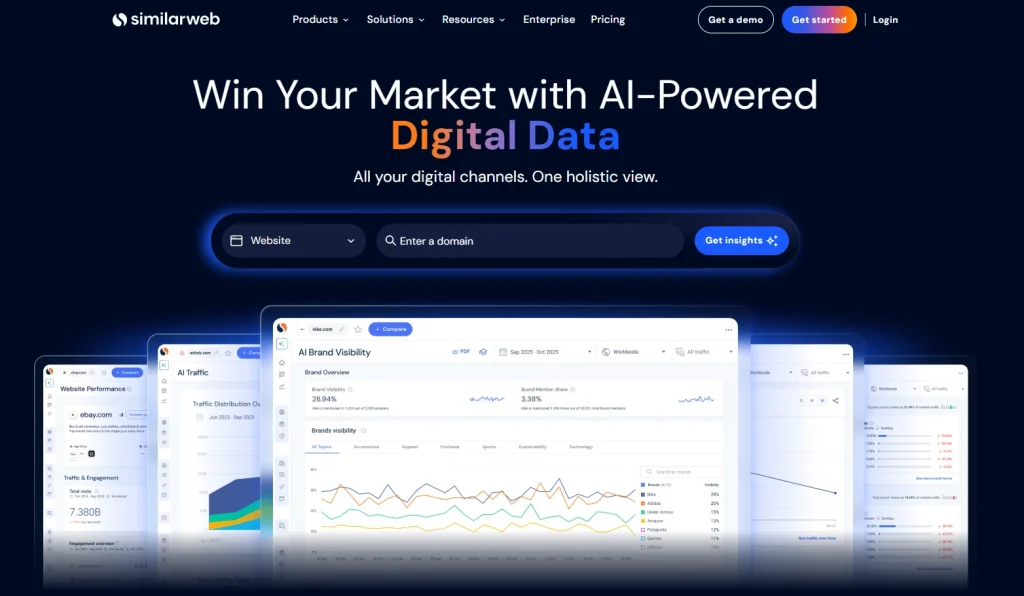
Similarweb is a digital intelligence platform that provides detailed insights into website traffic, audience behavior, and channel performance across web and mobile environments. It is widely used for competitive research and benchmarking, especially when understanding how competitors acquire and retain users is a priority.
Covering over 100 million websites and 4.7 million mobile apps across 210+ countries, Similarweb helps teams get a broader view of digital market share and audience dynamics.
Key features of SimilarWeb
- Traffic & audience analysis: Provides detailed visibility into competitor traffic sources, engagement metrics, and audience demographics.
- Competitive benchmarking: Enables comparison of traffic share, engagement, and audience overlap against competitors and industry benchmarks.
- Keyword & SEO intelligence: Combines keyword data, SERP tracking, and organic vs. paid insights to support search strategy.
- Mobile app intelligence: Tracks competitor app performance, including downloads and engagement across mobile ecosystems.
- Real-time alerts & market trend monitoring: Delivers alerts on traffic shifts, keyword changes, and emerging market trends.
- API & integrations: Integrates with analytics, CRM, and ad platforms to embed competitive data into workflows and reporting.
Who is Similarweb best suited for?
Similarweb is best suited for digital marketing, growth, and strategy teams that need a broader understanding of competitor traffic, audience behavior, and channel performance. It is particularly valuable when the focus is on benchmarking digital presence and identifying where competitors are gaining or losing market share.
Pros:
- User-friendly interface that is easy to adopt and navigate.
- Provides in-depth benchmarking of competitors and the market.
- Delivers robust keyword and referral analytics to better understand competitive positioning.
Cons:
- Pricing tiers can seem high for startups and small businesses.
- G2 mentions data inaccuracies and, at times, insufficient data in certain contexts, especially for websites with low traffic.
- At times, the platform is unable to accurately track granular metrics such as in-app events or user journeys compared to other competitor analysis tools for SEO.
Pricing: According to the Similarweb official website, its monthly pricing starts at $199.
6. Moz Pro
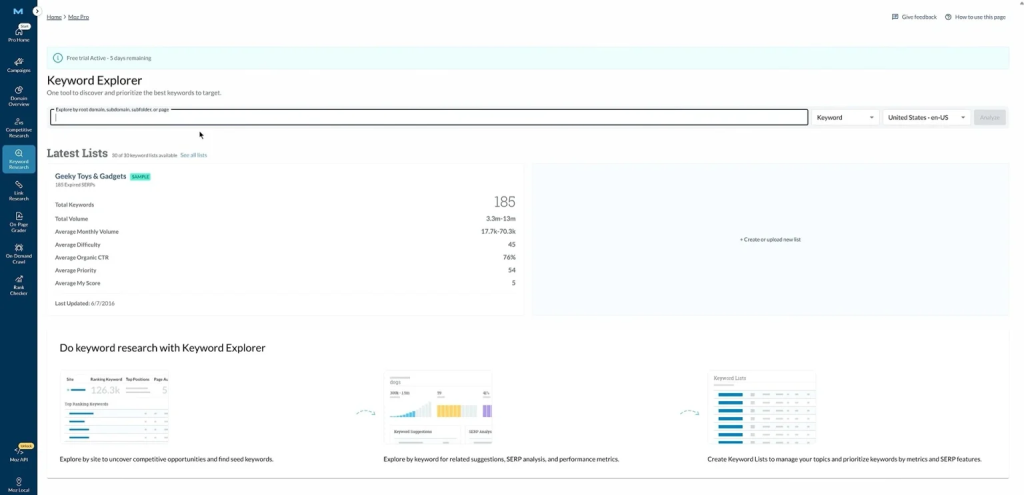
Moz Pro is a comprehensive SEO software suite known for its structured workflows, accessibility, and widely recognized Domain Authority (DA) metric. While it includes competitor analysis tools, its primary strength lies in helping teams manage core SEO activities such as keyword research, site audits, and rank tracking in a more guided and user-friendly way.
It is often chosen by teams that want reliable SEO insights without the complexity of more feature-heavy platforms.
Key features of Moz Pro
- Domain Authority (DA) metric: Uses a widely adopted metric to benchmark website credibility and competitive strength.
- Keyword research with difficulty scoring: Identifies and prioritizes keywords using difficulty scores, search volume, SERP analysis, and intent-based grouping.
- Site crawl & technical SEO auditing: Crawls websites to detect technical issues and provides prioritized recommendations with on-demand validation.
- Rank tracking: Tracks keyword rankings daily with clear visualizations to monitor and communicate performance trends.
- Link Explorer & backlink analysis: Analyzes backlink profiles and uncovers link-building opportunities, including competitor link gaps.
- Local SEO tools: Supports optimization for location-based search with tools tailored to geographic targeting.
Who is Moz Pro best suited for?
Moz Pro is best suited for small- to mid-sized businesses, in-house marketing teams, and SEO practitioners who want a reliable, easy-to-use SEO platform. It is particularly effective for teams earlier in their SEO journey that need structured workflows for keyword research, site audits, and rank tracking, rather than advanced competitive analysis.
Pros:
- Users have repeatedly mentioned the intuitive interface of the platform.
- Moz Pro provides a comprehensive SEO toolset that is useful for tracking competitors’ SEO strategies, comparing performance, and identifying optimization opportunities.
- The platform has built a strong community through quality education and training resources, which adds significant value for continuous learning in SEO and digital marketing.
Cons:
- Occasional data delays and local SEO gaps have been noticed.
- In-depth use of the platform still requires an initial learning curve.
- Many users have reported a smaller keyword database and limitations in keyword exports.
Pricing: According to the Moz Pro official website, it offers three monthly pricing plans: Standard (for small businesses with basic SEO needs) at $99, Medium (for those who need SEO, AI, and GEO services) at $179, and Large (for enterprise-wide services) at $299.
7. Ahrefs
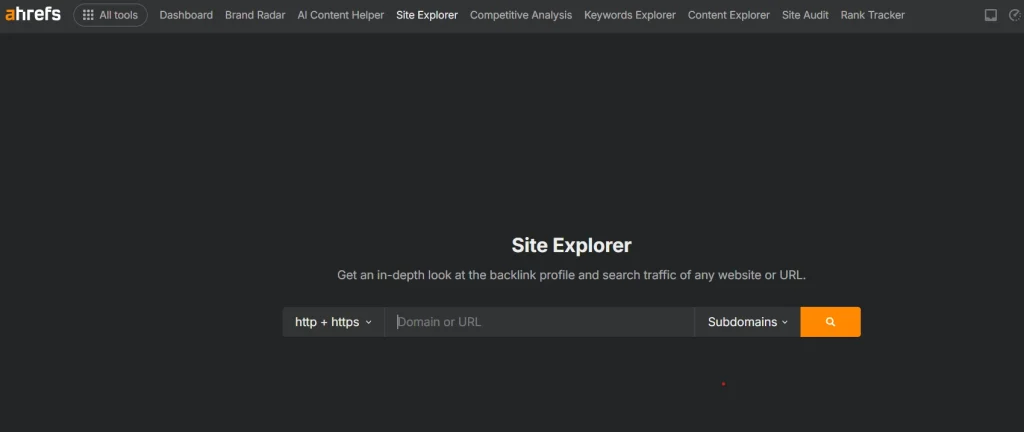
Ahrefs is a widely used SEO and competitor research software known for its depth in backlink analysis and organic search intelligence. It is particularly valued by SEO professionals and agencies that rely on accurate data to understand how competitors are driving traffic through content and links.
With one of the largest backlink indexes available, Ahrefs is often the tool teams turn to when their competitive analysis is centered on link-building strategies, content gaps, and organic visibility.
Key features of Ahrefs
- Site Explorer (competitor research): Analyzes competitor traffic, top pages, keywords, and backlinks to reveal drivers of search visibility.
- Keywords Explorer: Provides extensive keyword data, including difficulty, volume, trends, SERP features, and cross-engine insights.
- Backlink database & Link Intersect: Delivers deep backlink analysis and identifies link opportunities by uncovering gaps versus competitors.
- Rank Tracker: Monitors keyword rankings over time with trend visualizations to track performance against competitors.
- Content Explorer: Identifies high-performing content based on traffic, backlinks, and engagement to guide content strategy.
- AI-powered features: Uses AI for keyword suggestions and content grading to optimize pages against competitor benchmarks.
Who is Ahrefs best suited for?
Ahrefs is best suited for SEO professionals, digital marketing agencies, and enterprise teams that prioritize backlink strategy, content performance, and organic search competition. It is particularly effective when the goal is to understand how competitors are building authority and driving traffic through content and links.
Pros:
- If you want to find out through competitor analysis which rival companies are ranking higher, which keywords they are targeting, what traffic they are attracting, and what their link-building strategies are, then Ahrefs is an industry-leading tool for that.
- Ahrefs has built a strong community and digital presence through its education-led content, offering widely praised tutorials and guides on content marketing and SEO.
- The platform provides intuitive dashboards that are suitable for managing multiple clients and portfolios.
Cons:
- The platform does not offer a free trial and can be expensive for small businesses.
- Ahrefs uses a monthly credits system, which can quickly get exhausted during site audits or bulk keyword exports, because of which you have to pay extra for more access.
- It lacks the monitoring depth and analysis for PPC ads and social media workflow integrations because of its heavy focus on organic SEO capabilities.
Pricing: According to the Ahrefs official website, it offers three pricing plans: Lite (for small businesses and personal projects) at $129, Standard (for freelancers and marketing consultants) at $249, and Advanced (for enterprise teams) at $449.
Best Social Media Competitor Analysis Tools
Social media competitor analysis tools are designed for teams that need to understand how competitors perform across social platforms, including brand visibility, audience engagement, sentiment, and share of voice.
Unlike SEO and digital marketing tools, which focus on search and traffic, these platforms are built to track conversations, content performance, and audience perception across social networks and media channels.
They help answer questions such as:
- How often are competitors being mentioned, and in what context?
- What kind of content is driving engagement for competitors?
- How does our share of voice compare across platforms?
- Are there shifts in sentiment or emerging risks around competitor brands?
- Which campaigns or posts are performing well for competitors?
Most tools in this category combine social listening, analytics, and reporting, allowing teams to monitor trends, benchmark performance, and respond to changes in real time. They are especially valuable for Brand and communications teams tracking perception and sentiment, social media teams managing engagement and content performance, PR teams monitoring media coverage and brand mentions and marketing teams analyzing competitor campaigns and audience response.
8. Brandwatch
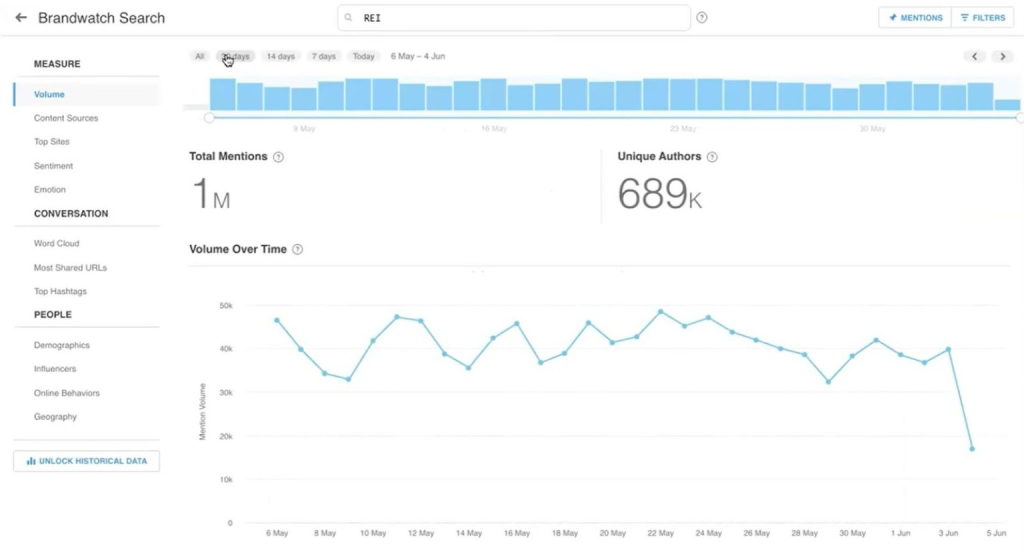
Brandwatch is an enterprise-grade social listening and consumer intelligence platform known for its scale of data coverage and advanced AI-driven analysis. It is designed for organizations that need to monitor and interpret large volumes of conversations across social media, news, forums, blogs, and review platforms.
With coverage across 100M+ sources and access to historical data, Brandwatch enables teams to analyze not just what is being said about competitors, but how perception evolves.
Key features of Brandwatch
- Social listening at scale: Monitors conversations across 100M+ sources with historical data for trend analysis and retrospective insights.
- AI sentiment & emotion detection: Identifies sentiment, emotions, and emerging themes to capture nuanced shifts in audience perception.
- Competitor monitoring: Tracks competitor mentions, sentiment, share of voice, and content performance with real-time alerts.
- Advanced keyword & Boolean filtering: Enables precise monitoring through customizable Boolean queries across brands, products, and topics.
- Consumer intelligence & audience analysis: Provides insights into audience demographics, behaviors, and interests for deeper market understanding.
- Multi-account management: Supports management of multiple brand accounts, ideal for enterprises and agencies.
Who is Brandwatch best suited for?
Brandwatch is best suited for large enterprise marketing, communications, and insights teams that need deep social listening, sentiment analysis, and competitor monitoring at scale. It is particularly effective for organizations that prioritize understanding consumer perception and tracking brand performance across multiple markets.
Pros:
- Recognized for deep social listening and sentiment analysis capabilities.
- The platform offers highly customizable dashboards that can be valuable to enterprises.
- Many users have appreciated its capabilities for real-time alerts and crisis monitoring.
Cons:
- Users have reported occasional functionality and scheduling issues.
- It can be expensive for small to mid-sized businesses, as it focuses mainly on enterprise customers.
- Some users have mentioned that the platform sometimes generates inaccurate data.
Pricing: Brandwatch offers three tailored plans: Consumer Intelligence, Social Media Management, and Influencer Marketing. However, there is no mention of pricing for any of these plans, and exact pricing requires a conversation with the sales team.
9. Sprout Social
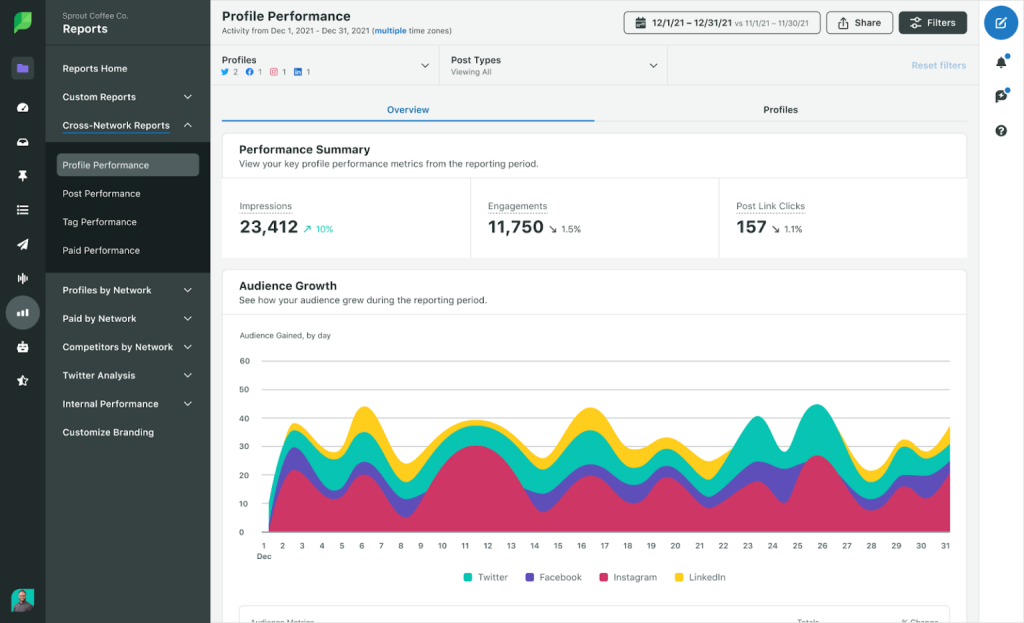
Sprout Social is an all-in-one social media management and competitive analysis software that combines publishing, engagement, analytics, and social listening in a single platform. It is widely used by teams that need to manage day-to-day social media operations while also tracking competitor performance.
Recognized as a consistent leader on G2 and ranked among the top software products, Sprout Social is designed to make social workflows more efficient while providing visibility into competitors’ performance across channels.
Key features of Sprout Social
- Smart Inbox: Unifies messages, comments, and mentions across platforms into a single, streamlined conversation hub.
- Publishing & scheduling: Enables content planning, approvals, AI-assisted creation, and cross-platform publishing from one calendar.
- Social listening: Tracks keywords, brand mentions, and competitor activity across social channels, including Reddit.
- Premium analytics & competitive reporting: Delivers customizable reports with performance metrics and competitor benchmarking.
- Customer care integration: Connects social interactions with popular CRMs and support tools to streamline customer service workflows.
Who is Sprout Social best suited for?
Sprout Social is best suited for mid-to-large organizations and social media teams that need a single platform to manage publishing, engagement, and performance tracking, along with basic competitor analysis. It is particularly effective when operational efficiency in social media management is as important as competitive insights.
Pros:
- The platform offers an intuitive interface experience, easy onboarding, and seamless collaboration.
- Sprout Social excels at scheduling content, publishing across multiple channels, and centralized inbox management.
- It offers robust analytics and reporting features.
Cons:
- The platform’s pricing is very high, which makes it out of reach for smaller businesses.
- Many users have reported that the mobile app lacks some features that are available in the desktop version, which creates obstacles in on-the-go or remote social media management processes.
Pricing: According to the Sprout Social official website, it offers four pricing plans: Standard (for small businesses managing a few profiles) at $199, Professional (for teams handling profiles at scale) at $299, Advanced (for cross-functional teams and workflows) at $399, and Enterprise (for organizations with large-scale social media workflows) at a quote-based price.
10. Talkwalker
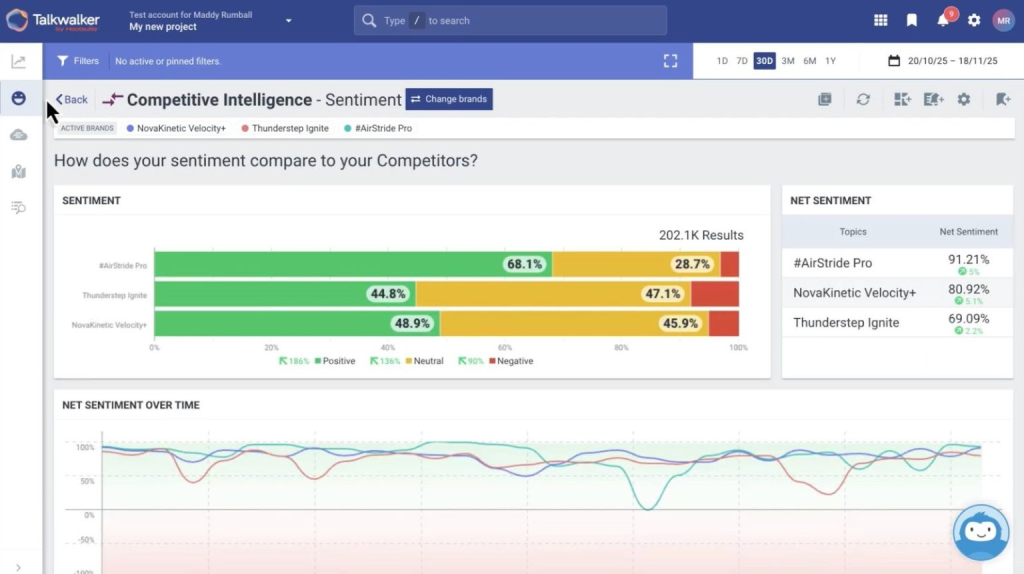
Talkwalker is an AI-powered social intelligence and brand monitoring platform that tracks conversations, analyses sentiment, and detects trends across social media and the broader web. With coverage across 150 million websites and platforms, it is particularly strong in helping organizations monitor brand perception and competitor activity in real time.
It stands out for combining text-based listening with visual analytics, making it useful for teams that need a more complete view of how brands appear across digital channels.
Key features of Talkwalker
- Real-time consumer insights: Processes Boolean queries to deliver real-time conversation analysis across social, news, blogs, and forums.
- AI sentiment analysis: Analyzes sentiment and topics to detect tone shifts, emerging themes, and perception changes.
- Visual analytics & image recognition: Tracks logos and visual brand mentions alongside text-based conversations.
- Data unification dashboards: Combines social, market, and customer data into customizable dashboards with interactive visualizations.
- Crisis & brand alerts: Detects spikes in mentions and sentiment shifts to enable rapid response to risks and opportunities.
- Location & product insights: Provides analysis by geography, product category, and audience segment for targeted insights.
Who is Talkwalker best suited for?
Talkwalker is best suited for brand, communications, and marketing teams at larger organizations that need real-time social monitoring, crisis detection, and global brand tracking. It is particularly valuable for companies managing brand perception across multiple regions and channels.
Pros:
- It is a strong enterprise-grade listening tool with advanced AI, image and video recognition, and broad coverage.
- The platform offers fast onboarding and a user-friendly interface.
- Deep competitive benchmarking for comparing your share of voice and audience growth against your competitors.
- It provides advanced sentiment analysis, reducing human language nuances such as sarcasm.
Cons:
- Limited Facebook/Instagram listening due to API constraints.
- Users have reported complexity in using the platform and occasional slowdowns, which can negatively impact the user experience.
Pricing: Talkwalker currently offers three plans: Core, Analyze, and Business. There is no mention of pricing for any of these plans.
11. Meltwater
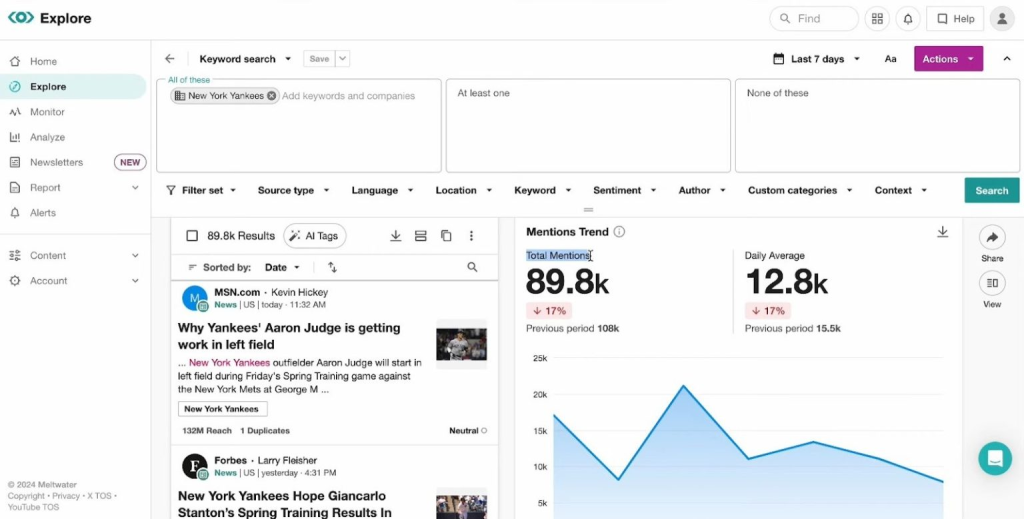
Meltwater is a comprehensive media monitoring and competitive analysis software that covers social media, online news, print, broadcast, and earned media. It is designed for communications, PR, and marketing teams that need a unified view of brand and competitor presence across both digital and traditional media channels.
Beyond monitoring, Meltwater also supports outreach and campaign workflows, making it a broader platform for managing earned media alongside competitor tracking.
Key features of Meltwater
- Media & social monitoring: Tracks brand and competitor mentions across social, news, blogs, forums, and broadcast media in one unified view.
- Social media management: Combines publishing, scheduling, and engagement tools to manage content and interactions seamlessly.
- Influencer marketing: Enables influencer discovery, tracking, and relationship management for targeted creator collaborations.
- Press & newsletter distribution: Supports direct distribution of press releases and newsletters to streamline PR workflows.
- AI insights (Synthesize AI): Uses AI to summarize data, surface key insights, and accelerate reporting.
- Competitive analysis & social analytics: Benchmarks performance against competitors using metrics like sentiment, engagement, and share of voice.
Who is Meltwater best suited for?
Meltwater is best suited for PR, communications, and marketing teams that need a single platform for media monitoring, competitor tracking, and outreach workflows. It is particularly effective when managing earned media visibility, and reporting is as important as tracking competitor activity.
Pros:
- The platform excels at capturing real-time brand mentions from global news, social media, and podcasts for PR teams.
- Purpose-built to contact and manage relationships with influencers and journalists.
- It helps you build customizable dashboards and automate newsletters to keep you updated with competitor news.
Cons:
- G2 mentions that Meltwater users sometimes face technical issues and lag in live monitoring.
- Many users have reported that the platform often generates inaccurate reports.
- The platform can be difficult to use and navigate.
- Coverage gaps for niche platforms and limited integration options.
Pricing: Meltwater follows a quote-based model, where the four plan options are: standard, pro, enterprise, and agency.
How to choose the right competitor analysis tool?
The best competitor analysis tool is not the one with the most features, but the one that aligns with how your team defines and uses competitor research.
Across the tools covered, the biggest difference is not capability—it is focus. Each category is built around a different type of question and user.
To choose the right competitor research software, start by identifying what your team actually needs to track:
- If your focus is on market shifts, competitor strategy, and cross-functional intelligence, a purpose-built competitive intelligence platform will be the right fit
- If your focus is on keywords, backlinks, paid campaigns, and digital performance, an SEO and digital marketing competitor analysis tool will be more relevant.
- If your focus is on brand presence, sentiment, engagement, and share of voice, a social media competitive analysis tool will deliver more value.
It is also important to consider how intelligence will be used internally. Ask these questions before choosing a tool:
- Which teams need access to competitor insights?
- Do you need real-time alerts, structured reports, or both?
- Will insights be used for strategy, execution, or sales enablement?
- Do you need depth in one channel or visibility across multiple signals?
In many organizations, there is no single tool that covers every requirement. It is common to combine a competitive intelligence platform with specialized competitor analysis tools for SEO or social media, depending on the use case.
The right choice comes down to clarity: once you know what decisions you are trying to support, selecting the right competitor research tools becomes significantly easier.
FAQs
What is the best tool for competitor analysis?
The best competitor analysis tool is the one that fulfills your business requirements and delivers exactly the insights you need. Since competitor analysis can have different outcomes based on which team is tracking competitors and what they want to monitor. For example, if your purpose is to generate competitive intelligence reports for strategic decisions, then Contify can be the best tool. Similarly, if you want to manage SEO workflows, analyze backlink strategies, or compare keywords, then Ahrefs and Semrush are the best seo competitor analysis tools.
What tool is used for competitor analysis?
If your goal is to monitor competitors, markets, customers, and industry changes from one place to support strategic business decisions, purpose-built market and competitive intelligence tools are the most suitable choice. If you want to improve SEO performance, analyze competitors' search visibility, and grow organic traffic, SEO and digital marketing tools are the best choice. If you want to monitor brand conversations, social media engagement, and audience sentiment, social media monitoring tools are the right choice. Competitor analysis serves different purposes based on the targeted outcome, and rarely does a single tool do everything. That is why it is important to use the competitor analysis tool that best aligns with your unique goals.
What is the best competitor analysis tool for a small business or startup?
For most startups, the immediate need is clarity on how competitors are acquiring users and gaining visibility. That usually means focusing on:
- Keywords and content
- Traffic sources
- Gaps in positioning
Tools like Ahrefs or Moz Pro tend to work well because they provide actionable insights without requiring a complex setup. At this stage, breadth is less important than focus. A full intelligence layer typically becomes relevant later, once multiple teams start depending on competitive inputs.
Are there any free competitor research tools worth using in 2026?
They still have a role, but it is a limited one. Free tools are useful when:
- You are doing initial market exploration
- The analysis is occasional, not continuous
- One person owns the process
They become harder to rely on when competitor tracking needs to be ongoing, shared across teams, and connected to decisions. At that point, the issue is not access to data but the lack of filtering and structure. That is usually when teams start moving toward platforms that can continuously surface relevant updates instead of requiring manual tracking.
Can I do competitor analysis for free?
Free competitor analysis tools are available that let you monitor competitors' activities to a certain extent. If your goal is to track competitors' websites, content, SEO efforts, identify trends, or compare search visibility, Google offers a free suite of tools. Tools such as Google Search, Google Trends, Google Search Console, and Google Alerts can help you perform basic competitor analysis without a cost.